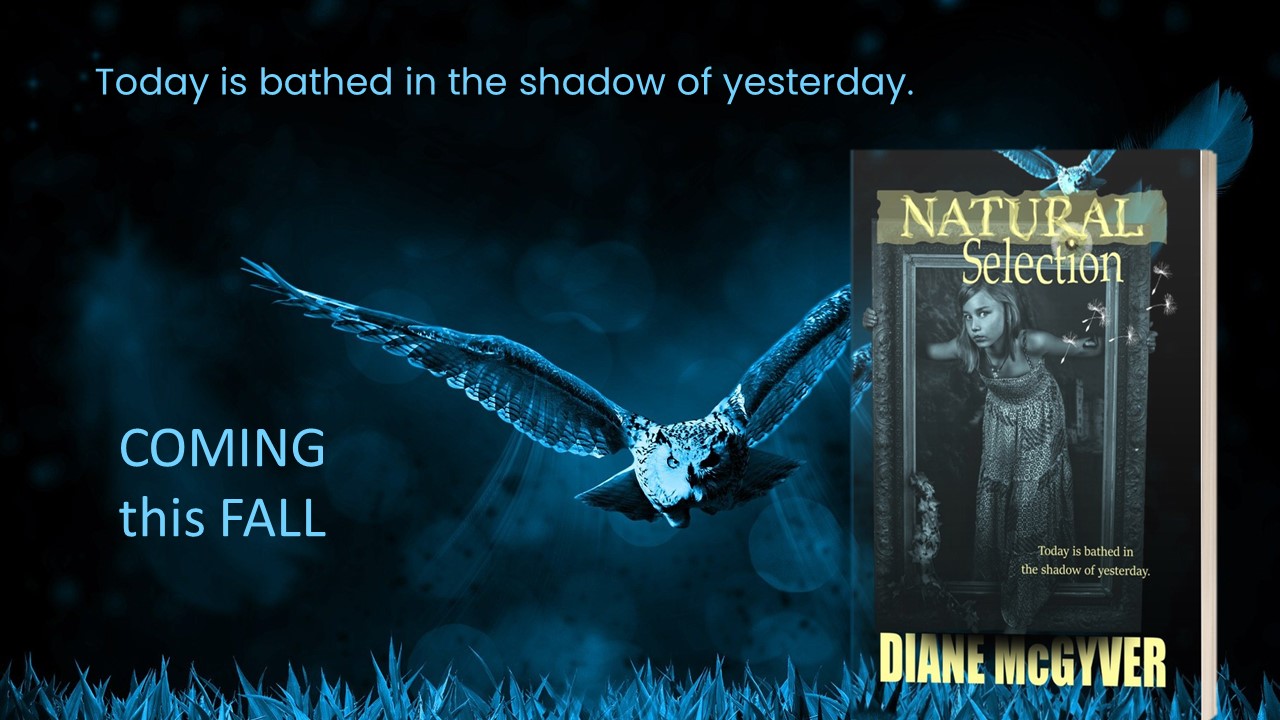
Diane McGyver’s first dystopian novel is set for release this month. Natural Selection takes place in 2051 in North America after the Devastation sets the world back two hundred years. It’s about starting over again but not from the beginning. Those who survived remember the old ways, and many want to reinvent that which was lost.
The cover for Natural Selection reveals many hints of the story within. It’s about a young girl peering into an unknown world. It’s about seeds. It’s about a crafty owl. It’s about the darkness that dwells in the heart of mankind, and those who hold the light to bring hope to the world.
Description
The year is 2051. Almost three decades have passed since the Devastation destroyed civilization. Only the strong and wise survived; the weak and intellects perished. New societies emerged, forging a future with skills from the distant past.
In Green Wood, Eloise has lived in seclusion with her uncle for 12 years. While they receive visitors to Larkspur Cottage, the number of friends they have can be counted on one hand. When strangers arrive and capture her uncle, she is forced to run, but who can she turn to when she doesn’t know the land outside Green Wood or where those friends live?
Melanie Ballard and John N. Grant released their book Mary Kaulbach’s Normal School Diary 1892-1893 earlier this spring. Copies are available through John N. Grant (contact him through email: jgrant@stfx.ca) and the Little White Schoolhouse Museum in Truro, Nova Scotia. Contact the museum through their contact page. While the book has yet to be added to their website, they have copies on hand to be purchased in person or through the mail.
Diane McGyver has penned her first dystopian novel and it’s set for release October 2021.
Natural Selection starts innocently enough: a young woman living an idyllic life with her uncle in a lush forest that provides the necessities of life. But the tranquility doesn’t last.
Here’s the description.
The wisdom of seeds grows naturally.
The year is 2050. Almost three decades have passed since the Devastation destroyed civilization. Only the strong and wise survived; the weak and intellects perished. New societies emerged, forging a future with skills from the distant past.
In Green Wood, Eloise has lived in seclusion with her uncle for the past 12 years. While they receive visitors to Larkspur Cottage, the number of friends they have can be counted on one hand. When strangers arrive and capture her uncle, she is forced to run, but who can she turn to when she doesn’t know the land outside Green Wood or where those friends live?
Historians Melanie Ballard and John N. Grant are set to release a wonderful piece of Nova Scotia history involving one student’s experience at the Normal School located in Truro, Nova Scotia. Over the past several years, they’ve been compiling material for the book, which includes the diary of Mary Kaulbach, a brief history of Mary’s life, images related to the subject and details to elaborate on the people, places and events mentioned in the diary.
Who was Mary Kaulbach?
Mary Kaulbach was one of nine children born to Elizabeth and Francis ‘Frank’ Kaulbach. She was born May 22, 1874 on the family farm at Conquerall Mills, Lunenburg County, Nova Scotia.
Mary’s birth record is found on the Nova Scotia Genealogy website under the following file name: Mary Kaulback [sic] birth Conquerall, Lunenburg County in 1874; Birth Registration: Year: 1874 book: 1817 page: 298 number: 626.
The record states Mary was born July 1874. No exact date appears to have been recorded unless it has faded over time. Her father, Frank, was a farmer who was born and was living at Conquerall. Her mother was Elizabeth (nee Fancy). Mary’s birth was registered at Bridgewater with the clerk J. Whitford. The informant was Reverend W. E. Gelling, which may indicate why the birth date was recorded incorrectly as he was a travelling clergyman, who recorded several births from his visits around the county.
Mary attended Normal School from fall of 1892 until June 1893.
Last year was extremely difficult for small businesses. Many were forced by government orders to shut their doors temporarily, and this caused many to shut them permanently. Those surviving into 2021 need our help more than ever. It’s vital we support local businesses that in turn support our communities and our country.
Supporting local means buying from small businesses in your community, the ones just down the street. It means buying products and services from your province and when you can’t find what you need that close to home, buy within your country.
In the big picture, if what you’re looking for is not in Canada, look to the rest of North America.
Quarter Castle Publishing has always supported Canadian businesses. We buy office supplies from local shops, and our books are printed in Canada. The only exception is when readers buy from Amazon. Then Americans are supporting their printers because the books are printed in the USA.
Quarter Castle Publishing will never ship our printing business overseas, and we certainly won’t do business with communist countries. We do NOT support communist regimes in any way, that includes financially.
The next time you consider buying a book, first ask, “Where was this book printed?” If the book was printed by a country governed by a communist regime, put it back on the shelf and buy another, one printed in Canada or the USA. If you don’t live in one of these countries, buy one printed in your country.
This year, it is vital we support local. It’s no longer just a gimmick; it’s a necessity.
Let’s keep our money as close to home as possible. Look for Printed in Canada and Made in Canada.
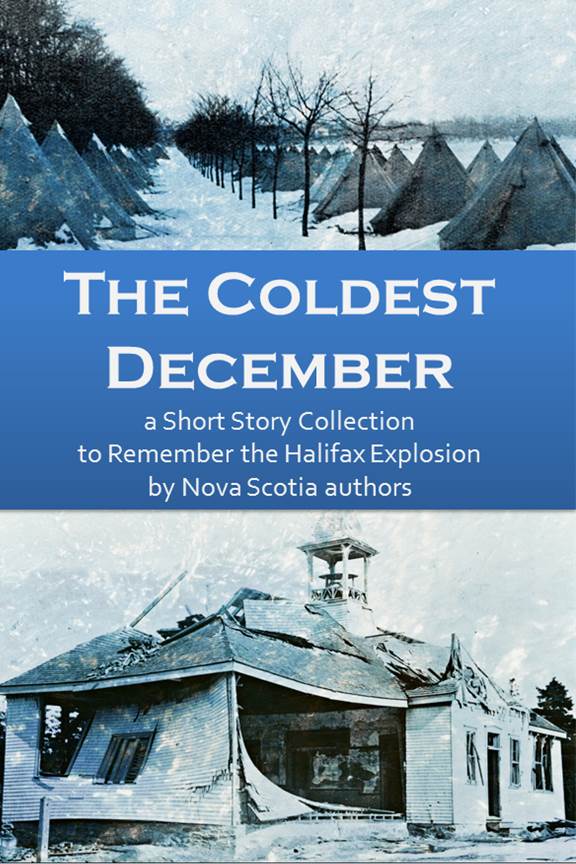
At midnight December 31st, the epic eBook and paperback sale for The Coldest December – a Short Story Collection to Remember the Halifax Explosion ends.
Original Stories by Nova Scotia Authors: Sheila McDougall, Phil Yeats, Lawren Snodgrass, Catherine A. MacKenzie, Polly J. Brown, Diane Lynn McGyver, Cheryl Lynn Davis, Bronwen Piper, Barbara-Jean Moxsom, Liana Olive Quinn and Annemarie Hartnett.
To learn more about this book, including the authors who contributed, visit The Coldest December’s page at Quarter Castle Publishing.
There’s only one week left of the blow-out sale of both the eBook and paperback for The Coldest December.
The Coldest December
a Short Story Collection to Remember the Halifax Explosion
On December 6, 2017, Nova Scotia will commemorate the one hundredth anniversary of the Halifax Explosion. More than two thousand people were killed and another nine thousand were injured from the largest man-made explosion of its time.
To pay tribute to the many victims, survivors and heroes who emerged from the disaster, Quarter Castle Publishing has gathered a collection of fictional short stories connected to the Explosion. Stories are set immediately before it, during it or in its aftermath.
Pick up a copy today at the following online outlets.
At 9:05* am 103 years ago, the shoreline of Halifax Harbour changed forever. The lives lost and destroyed that day left a deep scare in those who lived in the communities along its shores. This included Halifax, Dartmouth, Bedford, Tufts Cove, Woodside and several other small communities.
The Coldest December, a short story collection published in 2017 to mark the one hundred year anniversary, contains 11 original stories by Nova Scotia authors. Stories either take place during the explosion or shortly afterwards. One takes place in 1944 when the second Halifax Explosion, a much smaller explosion, took place.
Here’s a snippet from Lawren Snodgrass’ “Harbour in Time”, the story that takes place in 1944 with survivors from 1917.
Harboured in Time
Lawren Snodgrass
Once again, the past invaded his senses, and the burnt oil licked at his lips. The flames engulfing the homes lining the Halifax street threatened to snatch him from the ground and hurl him into the ocean. He glanced up and saw a dark figure hanging from the electric lines. His heart beat faster, and he feared it would leap from his chest and race off without him. A feral dog ran past him, throwing off his balance. He stumbled, but the girl he had rescued from the rubble held him securely, and he regained his step.
Tuft’s Cove School
“This way,” she cried, pulling him onto an unfamiliar street.
Unsure of her advice, he searched the area desperately, hunting for the way out of the war-torn downtown. He bulked and his feet grew heavy, eventually slowing to a stop. The heat lashed out at his face, and he feared any movement would make it unleash its fury.
“Come on! We have to go!”
The muffled sound of yelling reached his ears, but he hesitated to find the source. The fire watched him and if he moved, it would capture him. Its flame wrapped around his arm and tried to pull him closer, but he braced himself and stood firm.
“Run or we’ll die!”
The fire screamed, but he knew not to move. A scorching slap to his cheek shot pain to his head, and he looked down at the girl with the green eyes.
“We have to go this way.” She pulled his arm and beckoned him forward.
He allowed her to lead him through the thick clouds and onto the street that took them past the inferno. Minutes later, they emerged from the thickest of smoke, and he looked up to see the outline of the town clock in the distance. They struggled on, and dark figures turned to human form, all moving towards the Citadel. The weight of the girl from the rubble grew, and he watched her struggle to keep moving up hill. He gathered his strength and with a surge of energy, he scooped her into his arms and carried her. She clung to him, sobbing quietly against his neck. They reached the far side of the hill where exhaustion brought him to his knees. They stumbled to a rock wall and flopped onto the cold, hard ground.
… to continue reading, pick up a copy of The Coldest December.
Recovering whatever they can from the rubble.
Book Sale: The Coldest December
Pick up a copy today at the following online outlets.
To learn more about this book, including the authors who contributed, visit The Coldest December’s page at Quarter Castle Publishing.
*Some reports say 9:04 am and 9:05 am, but the majority found state 9:06 am. Regardless of the time and the clocks that stopped on the second it happened, it was a crisp, late fall Thursday in December 1917.
From December 2nd to December 6th, the Salvation of Mary Lola Barnes by Diane McGyver is on sale for 99 cents. That’s a $4.00 savings. This sale takes place only in Canada.
Reviews are starting to appear for the novel classified as Women’s Fiction / Inspirational / Mid-life Awakening / Romance.
She reserved the most convenient lies for herself
Mary Lola Barnes has everything: a loving husband, two wonderful grown children, good friends and a lovely home. She has no business asking for more. It doesn’t matter if she feels something is missing. She’s just being silly. After all, what could she ask for? When new friends enter her world, she’s ill prepared for the harsh light that shines on the imperfections in her life. It reveals the emptiness she refuses to acknowledge.
One of the stories in The Coldest December is “Business as Usual” by Phil Yeats. It’s about a man who joins the police force in Halifax. Under normal circumstances, his application would have been rejected due to poor eyesight. However, given the shortage of men because of the First World War, he was accepted. This is his story. Here’s the first few paragraphs.
Business as Usual
Phil Yeats
“Jenkins,” Morrow, the duty sergeant, called out as I followed two other patrolmen into the Halifax Police Station. “Get over here. Now!”
After finishing school in the spring of 1916, I’d volunteered for the army. I’d been declared unfit for service because of my poor vision and thrown back onto the streets, an outcast as I’d been through my school days. I’d always been excluded from sports and treated as an invalid because I wore spectacles.
Rejection by the army turned me into a different sort of pariah. Everyone saw me as a big, strong lad shirking my responsibility to fight the Hun. It didn’t matter that I squinted at them through thick lenses and protested that I’d attempted to join the army. I was seen as a failure, a weak, passive coward who wouldn’t fight for his country.
That fall, I joined the police force, thinking it was one way to do my patriotic duty and help protect the home front. The police wouldn’t normally accept spectacles-wearing recruits, but they were short of men after the exodus of young constables to the army and navy. They accepted but didn’t welcome me, and I joined patrolmen who were mostly too old for war service. Finally, in the days following the explosion of the French munitions ship SS Mont-Blanc on December sixth, 1917, I became part of the team.
“Yes, sir,” I said as I turned toward the sergeant’s desk.
Sergeant Morrow stared at the duty roster posted on the wall beside him. “The police are no longer needed for rescue duty, and tomorrow is your day of rest. In recognition of the extra hours you’ve put in, I’m also giving you the rest of this day. Report for work at 0800 hours, Friday, when you will return to your normal schedule.”
“Sir, does that mean we are no longer part of the rescue effort?”
“That’s what I said, Jenkins. Friday you return to regular patrolman’s duties.”
After leaving the Duke Street station, I walked to Gottingen Street and headed for the centre of the Richmond district and the house where I rented a room. The explosion that had levelled more than a square mile of Richmond must have destroyed the house, but I hadn’t been back since I left for work on the morning of the sixth.
…To continue reading, pick up a copy of The Coldest December.
Book Sale
Both eBook and paperback editions of The Coldest December are on sale until the end of the year.
Pick up a copy today at the following online outlets.
Scarlett and her friends were caring women, who enjoyed each other’s company. Their regular visits to the tavern were innocent and good for the soul. She would go again, and she would wear the burgundy dress she had bought at work. She’d also get her hair cut. The other women used getting out together as an excuse to dress up, and she would, too. As Sonya said, Nowadays, the only time we dress up is to attend a wedding or a funeral. We deserve more than that. Mary agreed.
Nodding off to sleep, she thought about the women around the table. Combined, they’d lived more than four hundred years. That was a lot living, loving and laughing. She smiled and allowed sleep to take her away.
From the Salvation of Mary Lola Barnes by Diane McGyver.
From now until Friday November 27th, the Salvation of Mary Lola Barnes is on sale for 99 cents in the United States and United Kingdom.
Most recent review for Northern Survival at Amazon.
“This story hit all my buttons for enjoying a story. It wasn’t too long for the time I had, it was adventure, it was dramatic (plane crash), not too much about blood and gore, two strangers having to learn to adapt and share strengths and weaknesses. And a hea to boot.” (hea is happily ever after)
This is a fast-paced read for a snowy weekend at the cabin or while lounging on the beach enjoying the sun. Download it today and save $4.00. Read it this weekend or save it for that snow storm we all know that’s coming.
One of the stories in The Coldest December is “Harboured in Time” by Lawren Snodgrass. During wartime, Halifax Harbour has always been a bustle of activity. Activity during the First World War resulted in the Halifax Explosion.
With this horrifying tragedy in the minds of survivors, when the Second World War began, bringing an increase in military traffic, they worried a similar event would happen.
On December 22, 1944, smoke rolling from a ship in the harbour no doubt triggered memories of the SS Mont-Blanc on fire. However, the Governor Cornwallis ferry was not laden with explosives, only diesel fuel and passengers. It made it safely to port, where passengers disembarked. The Nova Scotia Archives website has a photograph of the Governor Cornwallis ferry engulfed in flames.
The smaller Halifax Explosion of 1945, involving volatile explosives, caused more damage, lasted longer and shook those who saw the rising smoke. The series of explosions from July 18 to the 19th originated at the ammunition depot in Bedford near the Harbour shoreline.
These two events – the ferry burning and the ammunition depot explosion – were used by Snodgrass in his short story.
Harboured in Time
Lawren Snodgrass
The warm breeze rustled the leaves on the potato plants as Wilber Coulson pulled weeds with a long-handled hoe. The showers the evening before and the warm July day had made the pesky plants explode overnight. Although Mathilda planned to weed, he insisted she rest instead. In her condition, she needn’t be in the sun working when he could tidy the garden after work. Their son Everett also helped with the chores while she recovered from the most recent bout of bronchitis. Doc Fraser left little doubt her illness would not clear unless she rested and avoided her womanly chores.
Wilber paused for a moment, wiped his brow and leant onto the hoe to stare off at the harbour a few miles away. From his vantage point on Break Heart Hill, he could see the growing cities of Dartmouth and Halifax, their streets divided by the deep body of water. From this distance, he could not make out people, but he knew they were there. Given the hour, most workers had gone home for the night, yet many remained on the docks, loading or unloading and tending to ships either bound for overseas or arriving from there. The war created traffic jams in the harbour he had not seen for more than twenty years.
The ferries between the cities carried all traffic that needed to pass from one shore to the other—trucks, carts pulled by horses or oxen and passengers—to avoid the long trip around the Bedford Basin. He watched the Dartmouth approach the dock on this side of the water, its stack pumping black steam into the almost clear mid-summer sky, and memories from last December drifted into his mind: the smoke, the terror in the passengers’ eyes, the frantic actions of the ferry crew.
He had been waiting to make the crossing when he heard shouts and looked to see thick black smoke pouring from the Governor Cornwallis ferry. It was still quite a distance from the dock, and onlookers speculated about the cause and whether or not help would go out to the ship or the ship would put ashore for assistance. Wilbur’s first concern was Would it explode? He recalled staring at the flames, unable to move or respond to questions. Once again, he was a fifteen-year-old boy shocked by terrible sights, sounds and smells and running for his life. The horrid taste of burnt oil resurfaced and sweat beaded on his forehead.
A sudden thud and cries for help jolted him from his nightmare, and he sprang into action as he had in 1917. The Governor Cornwallis had docked. Passengers scrambled for shelter, and workers directed the trucks off the burning ship. Wilbur helped an elderly couple to safety, then returned to help a mother and her four children, then a wounded soldier on crutches who had returned from overseas only the week beforehand.
Book Sale
Both eBook and paperback editions of The Coldest December are on sale until the end of the year.
Pick up a copy today at the following online outlets.









 Quarter Castle Publishing